(Last Updated on May 7, 2025 by Amiee)
Chinese people have been eating porridge for thousands of years. In the famous Chinese medicine classic Treatise on Febrile Diseases, the author tells patients to eat porridge made of rice and water after taking Chinese medicine to help the medicine work and promote recovery. This shows the benefits of porridge to the body.
Later, many Chinese medicine doctors added Chinese herbal medicine to porridge for treatment or health care, which was called medicinal porridge. Medicinal porridge is well known to people and has become a dietary therapy method of using medicine to treat diseases and porridge to strengthen the body.
Medicinal porridge uses japonica rice or glutinous rice, and adds Chinese herbs and water to cook into porridge. Usually, no more than three kinds of Chinese herbs are added. Many medicinal porridges only add one kind of Chinese herbal medicine.
Why eat medicinal porridge?
Traditional Chinese medicine has always attached great importance to the function of the spleen and stomach, emphasizing that the spleen and stomach are the foundation of acquired constitution. Rice and glutinous rice have the functions of strengthening the spleen and stomach and replenishing the middle qi. Combined with Chinese medicine, they work together to achieve the purpose of curing diseases and have the function of replenishing the body.
Today’s medicinal porridge is chive porridge. This garlic chive is a kind of vegetable with flat leaves, and it is not a Chinese medicine in a strict sense.
Chive is warm in nature and sweet in taste, and enters the liver, spleen, stomach and kidney meridians. Chinese medicine believes that chive has the effect of warming and nourishing the kidney yang. The famous medical book (Compendium of Materia Medica) writes: Chive porridge, warms the middle and warms the lower. Chive porridge has a therapeutic effect on cold pain in the waist and knees, spleen and stomach deficiency, and chronic diarrhea.
How to make chive porridge
Ingredients
* Japonica rice, 30 g, washed
* Water, 1000 ml
* Chinese chive, 30 g, chopped
Instructions
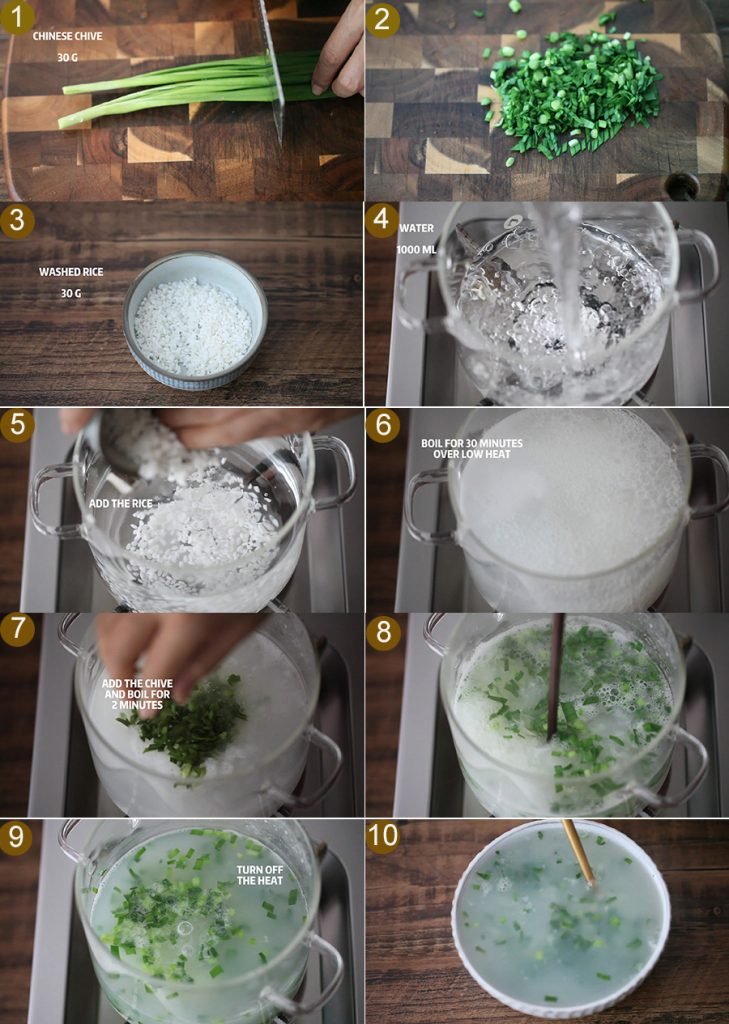
- Add the washed rice to a pot, add the water, boil it on low heat for 30 minutes after the water boils, then add chopped chives, cook for 2 minutes, and turn off the heat.
2. The chive porridge is ready.
Chive porridge can be eaten every day, preferably in spring, not suitable in summer.
People with yin deficiency and internal heat and eye diseases are not suitable for eating chive porridge.